
The Offset Equation: How to Calculate the Perfect Wheel Spacer Size for Your Build
If you’ve ever looked at your car from the front or rear and felt the wheels looked “sunken” into the body, you are dealing with an offset issue. Getting that perfect “flush” look—where the tire sidewall sits right at the edge of the fender—is the holy grail of automotive stance.
At Orion Motor Tech, we know that achieving the perfect fitment isn’t just about guessing; it’s about math. For 20 years, we’ve provided the high-quality hub centric spacers needed to bridge the gap between “standard” and “custom.”
Here is how you calculate the perfect wheel spacer size for your specific build.
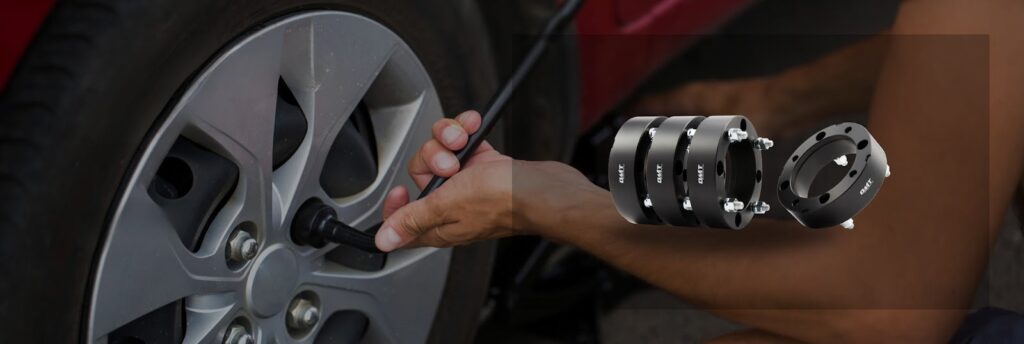
Step 1: Understanding Offset (ET)
Before you buy spacers, you need to understand what they are actually changing. Offset (often stamped on your wheel as ET) is the distance from the mounting surface of the wheel to its true centerline.
- Positive Offset: The mounting surface is toward the front (outside) of the wheel. This pulls the wheel inward toward the suspension.
- Negative Offset: The mounting surface is toward the back (inside). This pushes the wheel outward.
The Goal: Adding a wheel spacer effectively decreases your offset, pushing the wheel further away from the hub.
Step 2: The “Straight Edge” Measurement
To find out exactly how much spacer you need, you don’t need a degree in physics—just a straight edge and a ruler (preferably in millimeters, as spacers are almost always sold in metric).
- Park on Level Ground: Ensure your steering wheel is perfectly straight.
- The Straight Edge: Take a ruler or a level and place it vertically against the outer edge of your fender, hanging it down past the wheel.
- Measure the Gap: Use your second ruler to measure the distance from the outermost part of the tire (or the rim lip) to the straight edge.
The Calculation:
If your measurement is 20mm, then a 20mm spacer will make your wheel perfectly flush with the fender. However, most enthusiasts choose to go 2–3mm thinner than the measurement to account for “fender rub” when hitting bumps.
Step 3: Checking for Clearance
Before you click “Buy,” you must ensure that pushing the wheel out won’t cause other problems.
- Suspension Clearance: Check the “inner” clearance. If you are adding spacers to clear larger brake calipers, measure the distance from the caliper to the wheel spokes.
- Fender Lip: Look at the inside of your fender. If it has a sharp metal lip, you may need to “roll” your fenders to prevent the tire from being sliced when the suspension compresses.
Step 4: Quality Over Everything
When you add a spacer, you are adding a new link in your vehicle’s structural chain. This is why Orion Motor Tech insists on using 6061-T6 aircraft-grade aluminum and 12.9 grade heat-treated studs.
A cheap, “no-name” spacer can fail under the stress of cornering. Our spacers are hub centric, meaning they align with the center of your axle to eliminate vibration and ensure the load is carried by the hub, not just the bolts.
The Final Formula
To summarize the “Perfect Stance” equation:
Current Fitment Gap (mm) – 3mm (Safety Buffer) = Ideal Spacer Size
Why Choose OMT?
Over the last two decades, we’ve refined our manufacturing to ensure that every spacer is precision-machined to a tolerance of 0.02mm. When you’re doing the math for your build, you need a product that matches those numbers exactly.