
Identity Verification in the Car Industry: Why It Matters for Buyers and Dealers
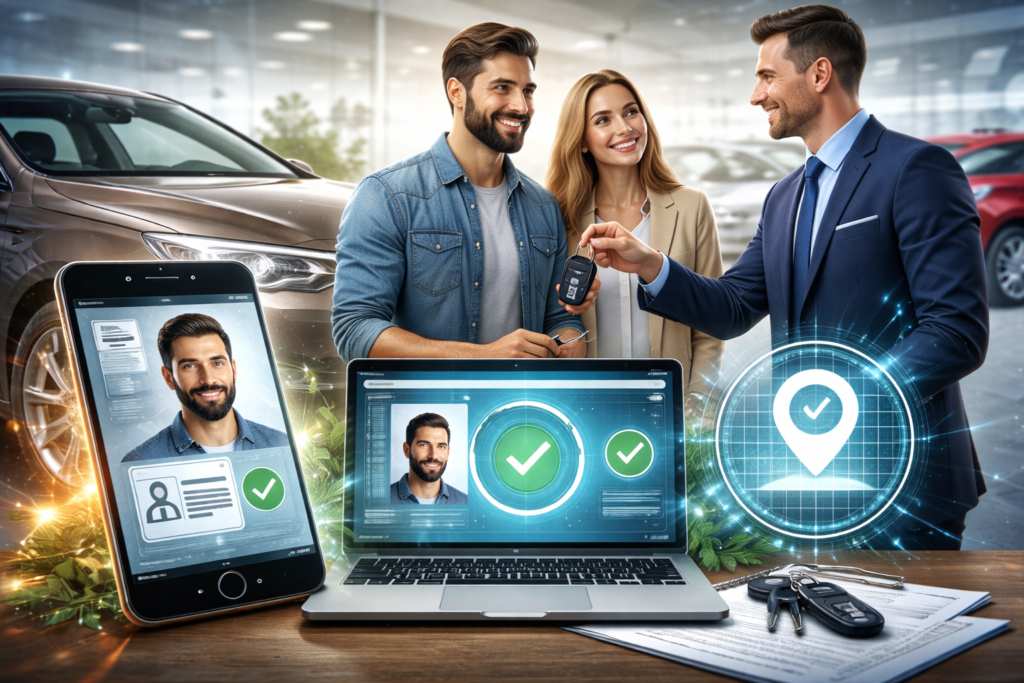
Buying or selling a car has never been more digital or more exposed to fraud. The rise of online vehicle marketplaces, remote finance applications, and contactless dealership experiences has dramatically expanded the attack surface for fraudsters targeting the automotive sector.
According to the National Insurance Crime Bureau (NICB), vehicle fraud losses in the United States exceeded $8 billion in a recent year, with identity-related schemes accounting for a substantial share of that figure. In the United Kingdom, the Finance and Leasing Association (FLA) has repeatedly flagged motor finance fraud as one of the fastest-growing categories of financial crime.
The scale of the problem reflects a simple reality: high-value transactions with complex paper trails create exactly the conditions that fraudsters exploit. A car or van worth tens of thousands of pounds is an attractive target. Finance agreements that spread payments over four or five years give criminals time to disappear. And traditional identity checks, asking a sales executive to eyeball a driving licence, are simply no match for the quality of forgeries now available on the dark web.
Understanding how identity verification solution works and why it has become essential across the automotive value chain is the first step toward protecting your business or making smarter choices as a consumer.
How Automotive Fraud Actually Happens
Before exploring solutions, it is important to understand the specific fraud typologies that the automotive sector faces. Criminals are sophisticated, and their methods are constantly evolving.
Synthetic Identity Fraud
This is the fastest-growing identity fraud category in financial services, and it has crossed into motor finance. A synthetic identity is constructed from a mix of real and fabricated information: a genuine National Insurance number or Social Security number combined with a false name, address, and date of birth. These identities have no fraud history and often pass basic credit checks, making them particularly dangerous for lenders.
Document Forgery
High-quality counterfeit driving licences, passports, and proof-of-address documents are readily available. A sales executive asked to manually verify a document has seconds to make a decision and lacks the tools to detect sophisticated forgeries. Hologram overlays, microprinting, and machine-readable zone (MRZ) data can all be convincingly replicated by professional fraudsters.
Fronting and Identity Substitution
In fronting fraud, a person with a good credit history applies for finance on behalf of someone who would be declined without the lender’s knowledge of the lender. The vehicle is handed to the actual driver, who has no contractual obligation to repay. Identity verification catches this by confirming that the person physically present matches the applicant on the finance agreement.
Vehicle Clocking and Title Washing
While not purely identity fraud, title washing, where a salvage or stolen vehicle is given a clean title through fraudulent documentation, relies on identity fraud to obscure ownership. Verifying the identity of every party in a vehicle title transfer significantly reduces this risk.
What Identity Verification Looks Like in an Automotive Context
Modern identity verification platforms have been designed for seamless integration into digital workflows, including the fast-moving, high-pressure environment of automotive sales and finance.
Here is how the process typically works for a car buyer applying for finance online or at a dealership:
- Document capture: The customer uses their smartphone or a dealership device to photograph or scan their driving licence, passport, or national identity card. The image is submitted to the verification platform in real time.
- Automated authenticity check: AI analyses the document’s security features, holograms, watermarks, font consistency, and MRZ data against the expected template for that document type and country of issue. Forgeries are flagged instantly.
- Data extraction and validation: Optical character recognition (OCR) pulls the customer’s details from the document. These are cross-referenced against credit reference agencies, electoral roll data, and mortality registers to confirm the individual exists, and the data is consistent.
- Biometric face match: The customer submits a selfie. Facial recognition compares it to the document photograph. Liveness detection confirms a real, live person is present, not a printed photo, a video, or an AI-generated image.
- Watchlist and AML screening: The verified identity is screened against sanctions lists, Politically Exposed Persons (PEPs) databases, and adverse media sources, a requirement for FCA-regulated motor finance providers.
- Instant decision: The platform returns a verified or flagged result within 30 to 60 seconds, allowing the finance or sales process to continue without unnecessary delay.
For technical teams and compliance managers evaluating solutions, detailed guidance on document verification covers everything from integration options to regulatory requirements for motor finance providers.
Why Dealerships and Finance Providers Cannot Afford to Skip It
Some dealerships still treat identity verification as a formality, a box to tick, rather than a genuine security measure. That attitude is becoming increasingly untenable, for three interconnected reasons.
Regulatory Obligation
Motor finance providers regulated by the Financial Conduct Authority (FCA) in the UK and equivalent bodies in the US, EU, and elsewhere are legally required to conduct Know Your Customer (KYC) checks before extending credit. This includes verifying the identity of every finance applicant. Failures can result in regulatory sanctions, unlimited fines, and in serious cases, the revocation of a firm’s permission to trade.
The Money Laundering Regulations 2017 in the UK impose specific Customer Due Diligence (CDD) requirements on regulated businesses, including motor finance companies. Identity verification is the foundational step of CDD compliance.
Direct Financial Exposure
When a fraudster successfully takes out a finance agreement using a false or stolen identity, the lender absorbs the loss when payments stop. For large vehicle values frequently £20,000 to £80,000, a single successful fraud can eliminate the profit margin from dozens of legitimate transactions.
Beyond the direct loss, recovery costs are high. Tracing a vehicle, pursuing legal action, and managing the reputational fallout of a fraud incident all add up. Preventing fraud at the point of application is dramatically cheaper than recovering from it.
Customer Trust
Consumers increasingly expect the businesses they deal with to protect their personal data and verify that their identity has not been stolen. When a buyer’s name and address are used to take out fraudulent finance on a vehicle they never purchased, the resulting credit damage, county court judgements, default markers, and debt collection calls can take years to resolve.
Dealerships and lenders that invest in robust identity verification are not just protecting their own interests. They are protecting their customers, and that is a meaningful trust signal in a competitive market.
Identity Verification for Online Car Marketplaces
The shift toward online vehicle sales has been one of the most significant structural changes in the automotive retail industry over the past five years. From subscription car services and direct-to-consumer electric vehicle brands to established used car platforms, more transactions are completing without any face-to-face interaction.
This creates both an opportunity and a challenge. The opportunity is to reach a dealership or platform that can serve customers anywhere in the country or globally. The challenge is verification — without physical presence, how do you confirm that the person on the other side of the transaction is who they claim to be?
The answer is automated, remote identity verification. Customers browse, select, and commit to a vehicle entirely online. At the point of finance application or purchase completion, they are prompted to verify their identity using their smartphone — uploading their driving licence and completing a brief biometric face check. The entire process takes under two minutes and can be completed from any location.
For platforms operating at scale, this means thousands of verifications can be processed simultaneously — with consistent accuracy and without the manual review bottleneck that would make that volume impossible to handle with human-based processes.
What Buyers Should Know About Identity Verification
If you have recently purchased a vehicle, applied for motor finance, or used an online car marketplace, you may have been asked to verify your identity digitally. Many buyers are unfamiliar with the process and have questions about why it is required and what happens to their data.
- Why am I being asked to verify my identity? Finance providers and regulated dealerships are legally required to confirm the identity of all applicants before extending credit or completing a regulated transaction.
- Is my data safe? Reputable identity verification platforms process data in compliance with GDPR and equivalent data protection laws. Your identity document and biometric data are encrypted, stored only for the period required by law, and never sold to third parties.
- What if my verification is declined? A declined verification does not necessarily mean fraud. It may reflect a document quality issue, a lighting problem with your selfie, or a data mismatch that can be resolved with a manual review. Contact the dealership or platform directly if your verification is unexpectedly declined.
- What documents are accepted? Most platforms accept a valid driving licence, passport, or national identity card. The specific documents accepted vary by platform and jurisdiction — the verification interface will indicate which are supported.
Conclusion
Identity verification is no longer a back-office compliance function in the automotive sector; it is a frontline business necessity. As fraud volumes climb, regulatory scrutiny intensifies, and digital sales channels expand, the dealerships, lenders, and platforms that invest in robust verification technology are the ones best positioned to protect themselves and their customers.
For buyers, the increasing prevalence of identity checks in automotive transactions is a sign that the industry is taking consumer protection seriously. For businesses, the investment case is clear: the cost of a sophisticated verification platform is a fraction of the potential loss from a single successful fraud, let alone the regulatory and reputational consequences of a compliance failure.
As the automotive sector continues its shift toward digital-first retail, identity verification will become as standard a part of the car-buying journey as a test drive. The organisations that build this capability now will be the ones leading the market when that transition is complete.