How to Use Social Media to Build Brand Authority Before Your SEO Kicks In
SEO takes months to show results. You publish optimized content today and wait three to six months before seeing meaningful rankings. During this gap, your brand sits invisible to potential customers. This waiting period kills momentum for new businesses that need visibility now. The solution is learning how to use social media to build brand authority before your SEO kicks in. Social platforms deliver immediate visibility while your SEO strategy matures in the background. Smart brands use social media as a bridge – establishing authority, building audiences, and generating revenue during the months while search rankings develop. When SEO finally delivers, you already have an engaged community ready to amplify your content. This dual-channel approach transforms the SEO waiting period from dead time into your most productive growth phase.
Here is exactly how to build brand authority on social media while your SEO investment compounds quietly in the background.
The SEO Waiting Period Nobody Warns You About
Understanding the timeline changes your strategy.
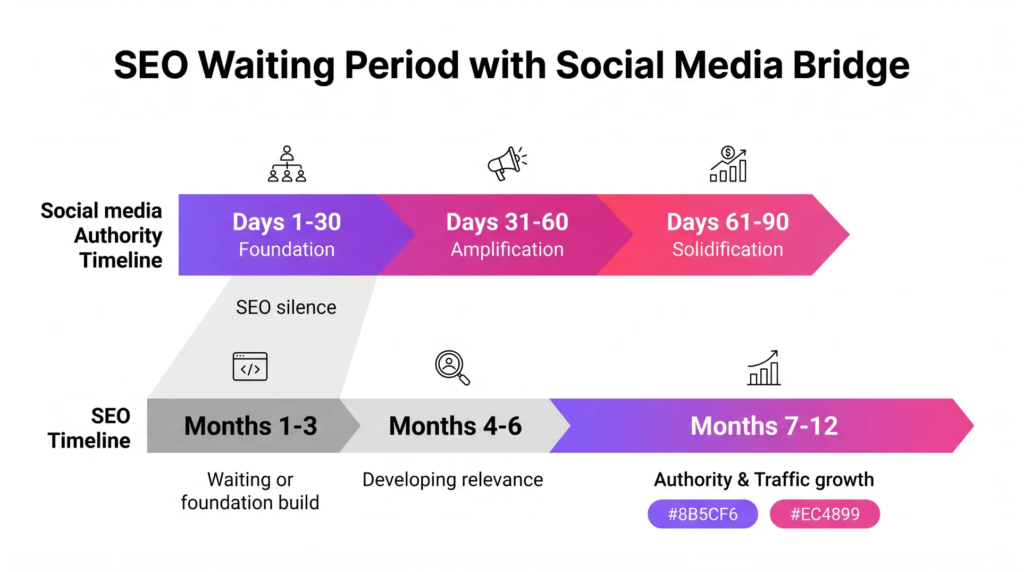
Months 1-3: You publish content. Google notices nothing. Rankings stay flat. Traffic at zero. Algorithms need time to crawl, index, evaluate, and trust new content.
Months 4-6: Some keywords start ranking. Position 47 for long-tail terms. Traffic increases from zero to 10 daily visitors. Revenue: still zero. The trickle phase.
Months 7-12: Rankings climb to page one. Traffic jumps to 1,000 daily visitors. Revenue flows. SEO becomes your best channel. But you waited a year.
The Authority Gap: During those first six months, competitors with established authority win all customers. Without brand recognition, even paid ads perform poorly. Cold traffic converts at 1-2%. Warm traffic from recognized brands converts at 5-10%. You need authority during the waiting period. Social media provides it in days, not months.
Why Social Media Builds Authority Faster Than SEO
Algorithm Access: Social algorithms give every account immediate distribution. Post your first TikTok and it reaches 200-500 people within hours. Google might not index your first blog post for weeks.
Engagement Feedback: Social provides instant feedback within minutes. SEO feedback takes weeks or months. Social’s rapid loop accelerates audience understanding.
Personal Connection: Social lets you build direct relationships through replies, DMs, and live sessions. SEO is impersonal – someone searches, reads, leaves. No relationship forms.
Content Flexibility: Social accepts all formats – video, images, text, audio, live streams. SEO demands specific formats and structure. Social’s flexibility enables rapid experimentation.
The 90-Day Social Authority Framework
While your SEO compounds invisibly, execute this social strategy.
Days 1-30: Platform Selection and Foundation
Choose one primary platform. Do not spread thin. Your audience concentrates somewhere specific. B2B? LinkedIn. Visual products? Instagram. Educational content? YouTube. Entertainment? TikTok. Pick where your customers actually spend time, not where you prefer to be. Complete your profile thoroughly. Use professional photos. Write clear value propositions. Include website links. First impressions matter enormously on social platforms. Invest in making your profile conversion-optimized from day one.
Create your content pillars. Define three to five topics you will consistently address. These pillars establish your expertise area. Random content builds no authority. Consistent expertise in specific areas builds massive authority. Document your pillars and commit to them for 90 days minimum.
Post daily. Consistency matters more than perfection in month one. The algorithm rewards accounts that show up reliably. Daily posting for 30 days signals commitment. It also forces you to overcome perfectionism and just ship content. Quality improves through volume during early stages.
Engage heavily with others. Spend 50% of your social time engaging with other accounts in your industry. Comment thoughtfully on 20-30 posts daily. This engagement accomplishes multiple goals: you learn what resonates in your industry, you get noticed by established accounts, you start building relationships, and the algorithm interprets engagement as a positive signal.
Days 31-60: Content Refinement and Amplification
Analyze your first 30 posts. Which three performed best? Why? Topic? Format? Hook? Call to action? Double down on winners. Create five variations of your top-performing content. The goal is finding your repeatable formula. Most creators never find it because they keep changing variables randomly. Systematic analysis reveals patterns.
Increase posting frequency strategically. If daily works, try 5 posts per week with one rest day. If struggling with daily, maintain consistency but improve quality. Frequency matters but only when combined with value delivery. Strategic use of social media engagement services can help amplify your best content during this phase, accelerating the authority-building process while maintaining authentic engagement patterns.
Launch one content series. A recurring format that audiences expect weekly. “Monday Myth-Busting” or “Friday Case Studies” or “Wednesday Q&A.” Series build anticipation and ritual. They also simplify content planning. Instead of inventing new ideas daily, you have a framework to work within.
Collaborate with similar-sized accounts. Reach out to 3-5 accounts in your space with comparable following. Propose simple collaborations – shared posts, mutual shoutouts, or joint content. Collaborations cross-pollinate audiences and validate your authority through association.
Days 61-90: Authority Solidification
Create your signature content piece. One comprehensive resource that demonstrates deep expertise. A detailed guide, an in-depth case study, or a powerful framework. This signature piece becomes your authority marker. Link to it often. Reference it in conversations. Make it your credibility proof.
Start producing platform-native content. Early on, you might repurpose blog posts or articles. By day 60, create content specifically for social platforms. TikTok-style videos, Twitter threads, LinkedIn articles, Instagram carousels. Platform-native content performs 3-5x better than repurposed content.
Engage with your growing community deliberately. By day 90, you should have meaningful follower base. These are not just numbers. They are people interested in your expertise. Reply to every comment for your first 100 followers. DM people who engage consistently. Host your first live session or AMA. Community engagement cements authority more than any other tactic.
Document social proof. By day 90, collect screenshots of positive comments, shares from industry leaders, or engagement metrics. This social proof transfers to your website, sales materials, and eventually supports your SEO content. Authority built on social media becomes evidence of expertise everywhere.
Platform-Specific Authority Strategies
LinkedIn: Post 3-5 times weekly with original insights. Comment on industry discussions. Write monthly articles. Use native video (5x more engagement). Services to buy LinkedIn followers help overcome visibility barriers for new B2B accounts.
Twitter: Tweet 3-5 times daily. Use threads for depth. Engage in trending conversations. Develop distinct voice and perspective.
Instagram: Focus on Reels as primary format. Post Stories daily. Create cohesive aesthetic. Use guides to organize best content.
YouTube: Create 8-12 minute videos solving specific problems. Optimize titles and thumbnails obsessively. Engage extensively with comments.
TikTok: Teach something concrete in under 60 seconds. Hook viewers in first 3 seconds. Post 1-2 times daily consistently.
Converting Social Authority Into Business ResultsDirect Response Integration
Include clear calls to action in your social content. Not every post needs one, but 20-30% should direct followers toward your business offerings. “DM me for details,” “Link in bio,” “Comment GUIDE for the free resource.” Make taking action easy. Social platforms restrict external links deliberately. Work within their constraints with creative CTAs.
Email List Building
Use social authority to build owned audiences. Offer valuable lead magnets – templates, guides, checklists – in exchange for email addresses. Your email list is the only audience you truly own. Social platforms can change algorithms or shut down tomorrow. Email remains. Every piece of social authority should convert some percentage of followers to email subscribers.
Content Cross-Pollination
Reference your SEO content from social media. When you publish blog posts or guides, create social content that previews key insights and links to the full piece. This serves two purposes: it drives traffic to your SEO content (engagement signals that help rankings), and it positions your website as the authoritative source of deep knowledge while social provides the appetizer.
Social Proof Collection
Systematically collect testimonials, screenshots of results, and positive feedback from your social audiences. This social proof becomes powerful marketing material. Feature it on your website, in proposals, in sales conversations. The authority you build on social platforms becomes evidence of expertise across all channels.
The Authority Transfer: When SEO Finally Kicks In
Month 6-12 is where the magic happens. Your SEO content starts ranking. But now you have advantages competitors lack. Your social following becomes content amplifiers. Every new blog post gets immediately shared to thousands of followers. This social amplification accelerates SEO results through increased traffic, engagement, and link acquisition probability.
Your brand has recognition. When people see your content in search results, they already know your name from social media. Click-through rates are higher. Dwell time is better. These engagement signals further boost rankings. People trust familiar brands more than unknown ones. Search results favor brands people recognize and trust.
You have real audience insights. Six months of social media taught you exactly what your audience cares about, what questions they ask, what language they use. Your SEO content becomes dramatically better because it addresses real needs in language that resonates. Generic SEO content ranks poorly. Audience-informed SEO content ranks excellently.
Your E-E-A-T signals are strong. Google evaluates Experience, Expertise, Authoritativeness, and Trustworthiness. Your active social presence with engaged following demonstrates all four. Google’s quality raters specifically check social profiles. Strong social authority supports stronger SEO performance.
Common Mistakes That Waste the Waiting Period
Mistake 1: Waiting for SEO before starting social. Start both simultaneously – SEO builds long-term foundation, social generates immediate visibility.
Mistake 2: Treating social as afterthought. Authority requires consistent presence and genuine engagement.
Mistake 3: Expecting overnight social authority. Requires 60-90 days of consistent execution. Push through the first 30 days.
Mistake 4: Creating content without strategy. Random posting generates random results. Strategic pillars build systematic authority.
Mistake 5: Ignoring platform-specific best practices. What works on LinkedIn fails on TikTok.
The Integrated Long-Term Strategy
Once both channels work, create cornerstone SEO content then extract insights for social posts. Social drives traffic to guides. Guides build SEO authority. The cycle reinforces itself.
Working with services that help you grow brand presence online accelerates multi-platform expansion by overcoming cold start problems systematically.